All posts filed under: Things for Cooking

Banana! Nendo Designs Packaging Design for Minion’s Favorite Snack

Nendo was recently asked to design the packaging for Shiawase bananas, high-quality bananas grown on a plantation in a national park located in the north-central region of the island of Mindanao in the Philippines. Grown using only organic fertilizers and adhering to the strict restriction on the use of pesticides, the produce became the first bananas to be awarded with 2 Stars at the International Taste and Quality Institute (iTQi) Superior Taste Awards in Belgium. To keep things as simple as a banana’s natural packaging, the Japanese design firm decided to steer clear of boxes or packing material, and instead applied stickers to the surface of the banana peel. The double layered sticker has a top layer that replicates the textural feel and colors of the banana peel, even down to the lifelike bruises and discoloration. When this top layer is peeled off, the second sticker reveals a description of the banana’s origins upon a background the color of banana flesh. Nendo also designed a paper carrier bag designed so that when the string handle is removed you can easily pick out the …

Kikkerland’s China Design Challenge

At an event held last month at the company’s shop in Manhattan, Kikkerland presented finalist designs from the Kikkerland China Design Challenge, an competition held in collaboration with Beijing Design Week Organization and Redstar Design Fund. Held during Bejing Design Week 2014, the theme of the challenge was “A Passage Into Design,” which encouraged young talented Chinese designers to present unique ideas based on Chinese heritage, history and mythology. The ideas also had to exhibit the quirky sense of humor and wit characteristic of Kikkerland Design. Nearly 1,000 design submissions were received, from which 30 were selected and prototyped during a workshop with professionals. Ultimately, 17  finalists were chosen from the challenge. During the New York event, an award was presented to challenge winner  Zhou Yi, who designed the Hutong Eraser, an eraser that represents the disappearing traditional architectural style that was once prominent in Beijing. “As the streets of Beijing are filled with more and more high-rise buildings, there are less and less Hutong style streets left,” says Yi. “The eraser will disappear as you use it, like the the disappearing Hutong.” The eraser, along with eight other finalists’ designs, will be produced and sold worldwide …

SMEG Small Appliances

Italian kitchen appliance maker SMEG has collaborated with the renowned Italian design firm Deepdesign to create an affordable line of retro kitchen accessories to coordinate with their line of ’50s-style inspired appliances. The new line includes a stand mixer, a 2- or 4-slice toaster, a blender, and two kettles in a range of colors from polished stainless steel to pastel pink. The kettles are available with an auto shut-off at 212° F or with a temperature setting from 122° F to 212° F that will be available in the second half of 2015. The blender, which is also available in the second half of the year, will come with several pre-set programs. Images courtesy of SMEG.

My Favorite New Products Now Available at the MoMA Store

Last week I got to get a sneak peek at the new products available at the MoMA store in New York City and through its online shop. Here, in no particular order, are my five favorite new gifts, gadgets, and gear now available through the store. 1. Amish Scooter This scooter-bicycle hybrid has been crafted by the Stoltzfus family, an Amish family in Pennsylvania, since 1978. This substantial scooter lets adults move on two wheels without worrying about balance and knee strains. It comes with a kickstand, basket, and rear brake and handbrake with black or orange powder-coated steel frame and fenders. I’m partial to the orange myself. Black, $360, Orange, $320. 2. Porthole Infuser Designed by the Chicago-based design firm Crucial Detail, the shape of this table-ready infusion vessel was inspired by submarine portholes. It can be used to create and hold 13 ounces of cocktails, infused oils, dressings, or whatever you want to conjure. Made of tempered glass, ABS, stainless steel, and silicone, the Porthole Infuser is dishwasher safe and comes with four recipes to get you started.  2” wide x 7″ …

Meet the Food Cycler: The First Residential Composting Appliance

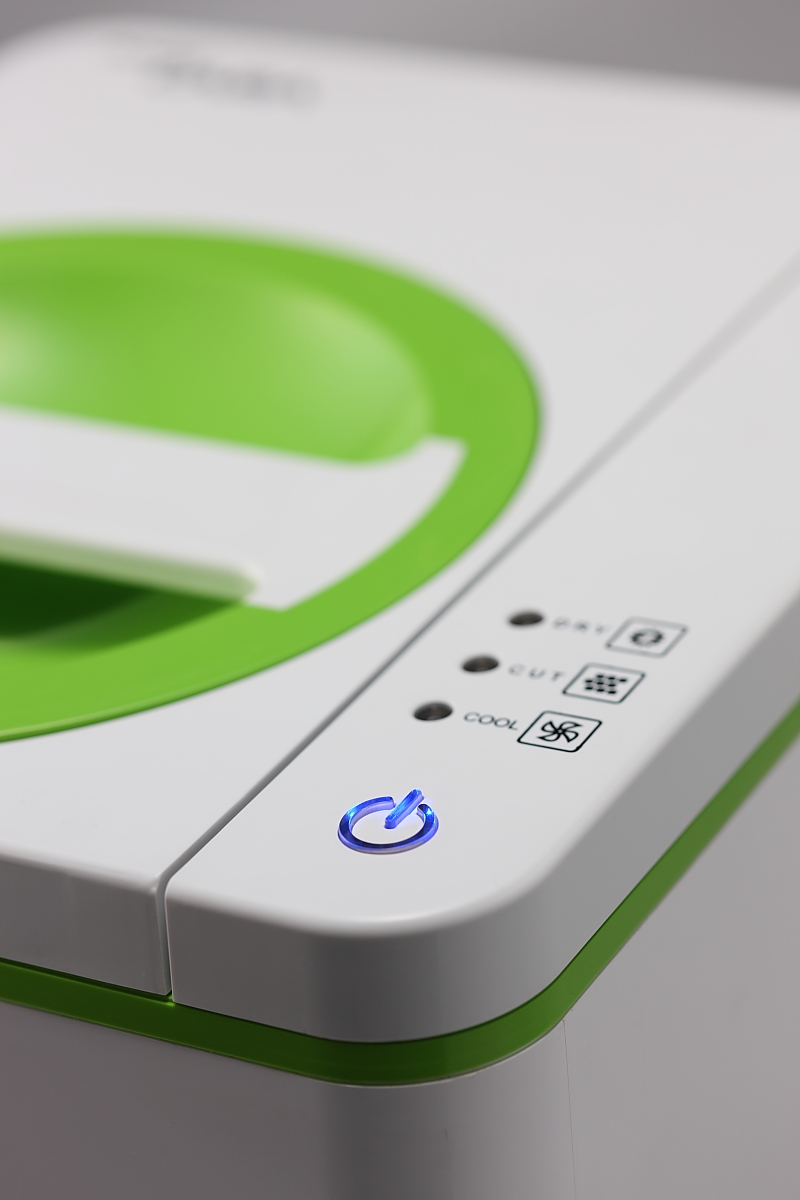
Most food waste can be turned into healthy compost for your garden or potted plants, but urban dwellers don’t have an easy way to compost their own waste into a nutrient-rich soil supplement without an outdoor composting container. Or, perhaps they do have the outdoor space, but other issues prevent them from composting outside (attracting hungry bears or violating local ordinances, for example). Food Cycle Science, the Canadian producers of organic food waste recycling solutions for the foodservice industry, offers an interesting new solution with the launch of the Food Cycler:Home, the first residential composting appliance. The 1 cubic meter size unit is able to operate anywhere there is an electrical outlet, and can be incorporated into the home from as early as the design phase. Food Cycle Science hopes the Food Cycler will help reduce the 475 pounds of food waste each person creates every year. The Food Cycler eliminates the use of drains, venting, or additives used in traditional composting process and is claimed to be completely odorless, noiseless, and cost-effective. Through a simple four step process, food (cooked or …

Studio Visit: Black + Blum

It was a bit ironic that my first visit to the London studio of Black + Blum was during the summer edition of the New York International Gift Fair. It was during that show several years ago where I first encountered the company’s quirky, functional gadgets. During a trip to London in August, I sat down with Martin Blum at the Black + Blum studio/shop located in the OXO Tower on the south bank of the Thames. Blum was holding down the fort at home while his business partner Dan Black introduced new products at the Javits Center in New York. Blum and Black first met when they were design students at Newcastle University. After working well together on a few group projects, “we realized that we had something going,” says Blum. “It’s quite rare to find someone you can work well with.”  A few years after school the two got together and started a firm in 1998. After operating as a design consultancy for two years, they had a literal “lightbulb” moment after designing …